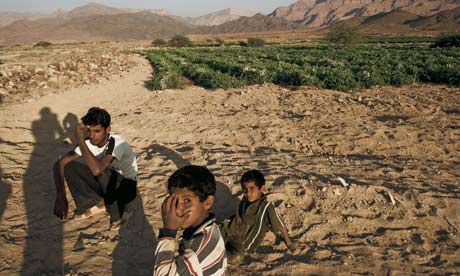
 It's hard to imagine why humans would have chosen the achingly arid stone desert of Wadi Faynan for their first settlement. But water would have been one important reason, says archaeologist Steven Mithen. When Neolithic men and women arrived 11,500 years ago, things were very different: the climate was cooler and wetter; the landscape was covered in vegetation including wild figs, legumes and cereals, and there would have been wild goats and ibex for meat.
Initially WF16, as it's now called, would have been a seasonal camp. But Mithen, professor of early prehistory at the University of Reading, and his fellow archaeologist Bill Finlayson believe that, gradually, people stayed longer. Sifting evidence from so long ago, the archaeologists can't be sure, but remains of food from different seasons and the scale of 'rubbish' piles suggest that about 10,000 years ago the inhabitants stopped moving altogether. If they are right, it would make this one of the oldest sites ever found where humans made a permanent settlement, learned to farm, and changed the course of human civilisation. But the tiny community drawn to water, which attracted successive waves of settlements, would eventually all but destroy the resource which made life possible. It is a pattern that's been repeated for millennia, around the world, and it now threatens us on a global scale.
First people cut trees for shelter and fuel, until rains swept away the soil instead of seeping into shallow aquifers, and the springs dried up. At least as long ago as the Bronze Age, farmers began mankind's obsession with diverting water for crops to feed the growing population. Meanwhile, the moist, cool climate which encouraged the first settlement was naturally becoming drier and hotter.
At least twice, historians believe, Wadi Faynan was abandoned. The first time possibly because of a sharp change in the climate, and later because it became too polluted. Today, Bedouin who survive in the valley have laid pipes down the dry stream bed to suck what is left of the spring in order to irrigate fields of tomatoes they have scratched out of the dry soil. But it's getting harder. According to local water lore, good rains now come in less than every other year.
The farmers in Wadi Faynan are not alone. Like communities around the world, they are paying the price for thousands of years of exploitation of our environment. Already, 1bn people do not have enough clean water to drink, and at least 2bn cannot rely on adequate water to drink, clean and eat - let alone have enough left for nature. Lack of water is blamed for many of the world's most distressing crises: millions of deaths each year from disease and malnutrition, chronic hunger, keeping children away from schools which offer hope of a better life. Mostly it is the poor who suffer, but increasingly rich nations are struggling, too. Australia has endured so many dry years that a leading climatologist has said it's time to stop saying 'gripped by drought' and accept that the lack of rain is permanent.
In parts of the US supplies are so vulnerable that last autumn the Red Cross delivered water parcels to the town of Orme in Tennessee. 'I thought, "That can't be the Red Cross. We're Americans!"' resident Susan Anderson told a reporter. In California, some farmers abandoned their crops this year as Governor Arnold Schwarzenegger declared the first state-wide drought for 17 years. Meanwhile Barcelona was so desperate that it began importing tankers of water from cities along the coast. Even in the notoriously wet UK, water has become such a problem in the crowded southeast that one company plans to build a desalination plant, the sort of desperate measure associated with oil-rich desert states.
The Stockholm International Water Institute talks about 'an acute and devastating humanitarian crisis'; the founder of the World Economic Forum, Klaus Schwab, warns of a 'perfect storm'; Ban Ki-Moon, the United Nations Secretary General, has raised the spectre of 'water wars'. And, as the population keeps growing and getting richer, and global warming changes the climate, experts are warning that unless something is done, billions more will suffer lack of water - precipitating hunger, disease, migration and ultimately conflict.
In a bid to avert this catastrophe, politicians, economists and engineers are pressing for dramatic changes to the way water is managed, from tree planting and simple storage wells, to multibillion dollar schemes to replumb the planet with dams and pipes, or manufacture freshwater from sewers and the sea.
The water crisis is an expression of the environmental catastrophe of human over-exploitation. This is the age the Nobel prize-winning chemist Paul Crutzen has called 'the Anthropocene', because the natural system has been so fundamentally altered by human activity. And it all began when people settled down and began to chop wood and farm.
'The start of sedentary communities is the start of the need to manage fresh water supplies,' says Steven Mithen. 'This is a starting point for our whole modern dilemma. It's gone from the concerns of individual settlements, to cities, to nations, and it's now a global issue.'
There is, in theory, plenty of water on the earth to sustain its 6.5bn people. More than 97 per cent of all the water on the planet is salt water, and most of the freshwater is locked up in the Antarctic and Greenland ice sheets. But that still leaves 10m cubic kilometres (km3) of usable water, circulating in cycles of evaporation and precipitation between the atmosphere and earth, where it appears in underground aquifers, lakes and rivers, glaciers, snowpacks, wetlands, permafrost and soil. Each km3 is equivalent to 1,000bn litres, or 1bn tonnes, of water - about the remaining annual flow of the River Nile.
On the other side of the equation, the UN says individuals need five litres of water a day simply to survive in a moderate climate, and at least 50 litres a day for drinking and cooking, bathing and sanitation. Industry accounts for about double the average domestic use. But agriculture needs much, much more - in fact, 90 per cent of all water used by humans. The water is not 'lost' from earth, but over-abstraction by irrigators means it is often moved from where it is needed. Tony Allan, of King's College London, estimates that, together, 6.5bn people need 8,000km3 of water each year - a fraction of what is theoretically available. 'There's certainly enough water for every person on the planet, but too often it's in the wrong places at the wrong times in the wrong amounts,' says Marq de Villiers, author of the 2001 book Water Wars
Three hours north of Wadi Faynan is the much greener Wadi Esseir, where Salah Al-Mherat and his family are one of millions of households in Jordan who feel the daily effects of inhabiting one of the driest countries on earth. Once a week, Al-Mherat gets water from the local irrigation co-operative for his fig, lemon, olive and grenadine trees and vegetables. For the rest he relies on rain. But since the Nineties the springs have been drying, sapped by demand from the nearby capital, Amman, and rain has been declining.
On a hot morning in April, Al-Mherat comes in from picking petits-pois, hitches up his smock and settles on to a pile of cushions. Fidgeting with a pot of scented tea he explains that the crops now barely cover their costs; he has to work as a security guard to supplement his income. 'When I started it was very good compared to now,' he says. 'The first impact was that the size of the irrigated area became reduced. People also changed what they irrigated, so the water now goes mainly to the trees - some farmers stopped completely from doing vegetables.' Al-Mherat says he keeps hoping things will improve, because he will pass the land to his sons. 'It's my life,' he says. 'But even if I'm positive, the reality is it's like the wish of the devil to go to paradise.'
Global population, economic development and a growing appetite for meat, dairy and fish protein have raised human water demand sixfold in 50 years. Meanwhile, supplies have been diminished in several ways: an estimated 845,000 dams block most of the world's rivers, depriving downstream communities of water and sediment, and increasing evaporation; up to half of water is lost in leakage; another 1bn people simply have no proper infrastructure; and the water left is often polluted by chemicals and heavy metals from farms and industry, blamed by the UN for poisoning more than 100m people. And still the rains are getting less reliable in many areas.
Underlying these problems is a paradox. Because water, and the movement of water, is essential for life, and central to many religions, it is traditionally regarded as a 'common' good. But no individuals are responsible for it. From Wadi Esseir to the arid American Midwest, farmers either do not pay for water or pay a fraction of what homeowners pay, so they have less incentive to conserve it and might deprive suppliers of funds to improve infrastructure.
The UN defines 'water scarcity' as fewer than 1,000m3 of renewable clean water for each person every year to drink, clean, grow food and run industry. By this measure half the world's population lives in countries suffering water scarcity. Jordan is one of the most water-scarce countries on earth, averaging just 160m3 of renewable water per person per year.
The result is that it is not just farmers who are rationed. The Al-Mherat family, like the rest of greater Amman, only get water to their house one day a week. A city of more than 2m people runs to the rhythm of 'water day', says Dr Khadija Darmame, who is part of a £1.25m project organised by Mithen and sponsored by Britain's Leverhulme Trust to study links between 'water, life and civilisation' in Jordan, from the earliest settlements to modern day.
Poor supplies and stagnant tanks occasionally lead to infections. But for most, the problem is drudgery. 'The first thing is to do the maximum laundry and then clean the house,' says Darmame. Children and men take a shower, 'and the last thing is for the women to take a shower, and then you need a few hours to fill the tanks,' stacked on every roof.
For millions of others, bad supplies are a question of life and death. Lack of clean drinking water and sanitation are largely blamed for the death of 11m children under five each year from disease and malnutrition; for nearly 1bn people who are chronically hungry; for 2bn who suffer what the UN's Food and Agriculture Organization calls 'food insecurity', because they do not have adequate food and nutrition for an 'active and healthy life'; and for keeping more than 60m girls out of school. These people then get caught in a water and poverty trap: two-thirds of the people who lack enough water for even the most basic needs live on less than $2 a day. 'Variability of water availability is strongly and negatively related to per capita income,' says Professor Jeffrey Sachs, author of Common Wealth: Economics For a Crowded Planet, and a special adviser to the UN Secretary General. Poor health, lack of education and hunger make it hard to escape.
Ultimately, lack of water is seen as a threat to peace. From genocide in Darfur to rows between states in India and the US, Ban Ki-Moon is one of several global leaders who have warned of further legal and armed disputes over water. Intuitively it is obvious people will fight over their most precious resource, but so far few conflicts have broken out. The idea of 'water wars' seized the public imagination in 2001 when Marq de Villiers's book of that name was published in the UK, but the author disagreed with the publisher's choice of title. De Villiers agrees that water is often an underlying cause of tension, but has only identified one water 'war', between Egypt and Sudan. 'You cannot do without water, so when shortages pinch, states do co-operate and compromise,' he says.
But if half the world's population lives in water-stressed countries, how do so many, from the breadbaskets of Asia to the sprawling cities in the arid American west, keep watering fields and running taps?
One reason is that water flows uphill to money, as the saying goes. Thus people in oil-rich Kuwait enjoy expensive desalination, while Palestinians suffer daily hardship; tourists in Amman can turn on the tap at any time, while those in the poorest areas of the city have access to water for a few hours each week. As Tony Allan says: 'Water shortages don't pose serious problems to gardeners in Hampshire or California homeowners with pools to fill.'
Another answer to the conundrum was identified by Allan, who in the Sixties became curious about why Middle Eastern countries without abundant water supplies were not suffering from a more obvious water crisis. The answer, he realised, was trade: by buying food, water-poor societies were 'buying' what he dubbed 'virtual water'. They were helped by farmers dumping grain into the world market once subsidies created massive over-supply. 'This potential tragedy was motoring on and hit the calm waters of the Americans and Europeans providing food [for the world market] at half cost, and the water contained in that food [was water] they didn't have to find.'
The other answer is that communities around the world have been forced to tap rivers and lakes and aquifers, sometimes millions of years old, far beyond the limit at which they can replenish themselves. Above ground, lakes are shrinking and rivers are being reduced to pathetic flows, or drying up altogether. Below ground, a largely invisible crisis is unfolding as millions of wells have been sunk into aquifers - 4m in Bangladesh alone. Many aquifers are replenishable, but not all, and many that can be recharged don't get enough rain to match demand. Sometimes the empty cavities simply collapse, putting them beyond use forever. In his recent book, Plan B 3.0, Lester Brown catalogues the results. In the breadbaskets of China, India, the US, Pakistan, Afghanistan, Iran, Saudi Arabia, Yemen, Israel and Mexico, water tables are falling, sometimes by many metres a year. Pumps are being drilled a kilometre or more to find water, thousands more wells have dried up altogether and agricultural yields are shrinking. These countries contain more than half the world's people and produce most of its grain, warns Brown. Meanwhile, almost forgotten amid the human suffering are the terrible consequences for the natural world: freshwater fish populations fell by half between 1970 and 2000, says the UN.
All these dams and irrigation channels and pumps and pipes allow billions of people to run up a gigantic global water overdraft. What worries experts is that there is no sign of humans withdrawing less water.
Two years ago, the International Water Management Institute (IWMI) published a report by 700 experts warning that one in three people were 'enduring one form or another of water scarcity'. 'Scarcity for me is when women work hard to get water, [or] you want to allocate more but can't,' says David Molden, deputy director of the Sri Lanka-based organisation.
Molden warns that the situation is becoming 'a little bit more critical', because of continuing rising demand for food, the recent boom in biofuels and climate change. To that can also be added another, poignant 'demand': the long-overdue realisation that nature also needs water, which in Europe and other countries has led to laws to ensure 'minimum environmental flows' remain in place.
For food alone, the World Bank estimates that demand for water will rise 50 per cent by 2030, and the IWMI fears it could nearly double by 2050. Whether these crops require rain or irrigation depends on where they are grown, and how much rain there is.
Like a great river fed by many tributaries, water is a conduit for the various effects of global warming: more variable rainfall, more floods, more droughts, the melting of glaciers on which 1bn people depend for summer river flows, and rising sea levels, threatening to inundate not just coastal communities but also their freshwater aquifers, river deltas and wetlands.
From the headline figures, climate change should be good news. Crudely, scientists estimate for every 1C rise in the average global temperature, precipitation will increase one per cent, as warmer air absorbs more moisture. The world's total volume would not change, but it would be recycled more quickly, affecting the majority of the world's agriculture which depends on the volume and timing of rainfall.
Balancing all these impacts, Nigel Arnell, director of Reading University's Walker Institute for Climate Change, calculates that the number of people living in water basins exposed to water stress will rise from 1.4bn to 2.9-3.3bn by 2025 and to 3.4-5.6bn by 2055. In fact, the greatest impact in Arnell's modelling is from rising populations, particularly in China and India, and, globally, climate change is actually reducing exposure to shortages. This may be good news for some, but masks huge disruption, as some regions fear too much water, while hundreds of millions of people start to run out.
It is impossible to attribute one farm's difficulties or one year's rainfall to climate change. But if climate is the statistics of weather, then the rain gauge this year on the farm of Sameeh Al-Nuimat, northwest of Amman, is typical of what the experts forecast. Al-Nuimat had noticed a gradual decline in rainfall for years, but this year it dropped off steeply and there was no rain at all in March, a critical time for summer crops. 'My father told me he'd never seen such a year,' he says.
Such dramatic events have injected urgency into discussions about Jordan's precarious water supplies, says Al-Nuimat, who is also an irrigation engineer at the Ministry of Agriculture. 'Before, when water was available, no one worried about it. But now there's interest - every night people speaking, every night debating, at every level, from the farmer to the planner to the politician. As a farmer I'd like to see drought-resistant crops; from a civil engineering point of view we should look for mega projects; and, if you're thinking about global planning, there should be acceptance of people moving from water-scarce regions to where water is available.'
Around the world the same debates are under way. Rich countries can make significant gains from domestic efficiency, but most of the world's population does not have power showers and swimming pools, or waste great quantities of food. Instead the main focus is on reducing water in agriculture, through more efficient irrigation, by engineering seeds to grow in more arid and salty conditions, and even shifting crops. 'If the world were my farm, I'd grow things in different places,' says David Molden. But even benign-sounding conservation is often unpopular. There is widespread resistance to raising prices for water (or energy for pumping) to increase efficiency, suspicion of genetic modification, and a reluctance among farmers to abandon water-hungry but lucrative crops when they are struggling to feed their family. 'It's a socioeconomic dilemma,' says Al-Nuimat. 'You can't stop now: it's the source of their life.'
Faced with public apathy and even resistance, responses have tended to focus on increasing supply. For decades the scale of ambition has been like a game of global engineering one-upmanship: rivers have been diverted across countries, pumps sunk kilometres into fossil aquifers, and bigger plants commissioned to recycle or desalinate water. And there is no sign of a let-up. As shortages become more desperate and costs and energy use fall, Global Water Intelligence forecasts that desalination capacity will more than double by 2015, and the potential to increase wastewater recycling is enormous, being only 2 per cent of volume.
But huge costs, environmental concerns and public distaste for drinking their 'waste' has forced many communities to reconsider simpler, traditional methods, too. Some of the ideas the earliest farmers would have recognised: tree replanting, ripping out thirsty non-native plants, stone walls to hold back erosion, and rain harvesting with simple ponds and tanks. Some have even urged a return to more vegetarian diets, which at their extreme demand only half the water of a typical American meat-eater's. This is, according to Lord Haskins, the former chairman of Britain's Northern Foods group and a government adviser, 'the most virtuous and responsible step of all'.
And when all options are exhausted at home, countries have another option: to import water in food and even industrial goods. Political meddling with subsidies makes trade a controversial 'solution', but by favouring regions with a 'competitive advantage' in water it can work. Globally the IWMI estimates irrigation demand would be 11 per cent higher without trade, and quotes a projection that imports can cut future irrigation by another 19-38 per cent by 2025. Saudi Arabia has gone further than most, announcing in February that it would stop all wheat production in a few years, though other countries might now be deterred by higher food prices.
Ultimately governments are being forced down several paths at once: to raise prices to reflect the true value of water to humans and the environment, invest in technology to improve efficiency and supplies, engage in more trade, and make peace with neighbours that can hold up incoming water or food. These will only be possible, though, if people can be lifted out of poverty, to afford higher prices, capital spending and imports. 'When you diversify your economy you solve your problems,' says Allan.
Looking back at the history of mankind's struggle for enough water, experience suggests the initiative which enabled humans to settle, farm and dominate the planet will provide many solutions. But sometimes we might have to accept defeat. 'On the one hand you can see this amazing technological ingenuity of humans, which throughout prehistory and history continually invented new ways to manage water supply,' says Mithen. 'On the other, the story of the past tells us that sometimes, however brilliant your technological inventions, they are just not good enough, and you get periods of abandonment of landscapes. We have got to be prepared to invest in technology, but also to recognise in some parts of the world there are going to be areas where we're going to have to say "enough's enough".'
A person uses about 50 litres of water a day; industry accounts for double that. But agriculture needs much more - in fact, 90 per cent of all water used by humans.
link
 Twelve years ago, Dolly the Sheep became the first mammal to be cloned from a living cell. Yesterday, scientists announced another first: the birth of cloned animals from frozen cells. In this case, the clones were produced from mice that had been kept in the deep freeze for up to 16 months.